.svg)
Share
Copied!


The boundaries of the telecommunications industry are rapidly disappearing. As telecom providers expand beyond network connectivity into content, IoT, and AI, the complexity of their IT environments has grown dramatically.
Against this backdrop, LG U+ set out to deliver a differentiated AX (AI Experience) to its customers. To achieve this, the company made a strategic decision to consolidate its fragmented monitoring environment and establish a unified, data-driven monitoring framework.
At the center of this transformation was WhaTap.
For LG U+, service reliability is directly tied to customer trust.
One of the service monitoring team’s core responsibilities is to continuously monitor infrastructure, networks, and software to detect incidents early and communicate them quickly. However, the existing environment presented significant operational limitations.
Different departments had historically relied on different monitoring tools, resulting in persistent data silos. When an incident occurred, identifying the root cause quickly was difficult, and interpreting monitoring data often depended on the knowledge of specific individuals.
Most importantly, LG U+ lacked a unified dashboard that could provide an at-a-glance view of service operations across the organization.
To address these challenges, LG U+ began transitioning the infrastructure architecture supporting its internal integrated IT system, U-Cube, toward containers and microservices architecture (MSA).
Rather than treating this as a purely technical migration, LG U+ made the strategic decision to redesign its broader IT operations and management framework at the same time.
LG U+ selected WhaTap as its partner for building a unified monitoring environment.
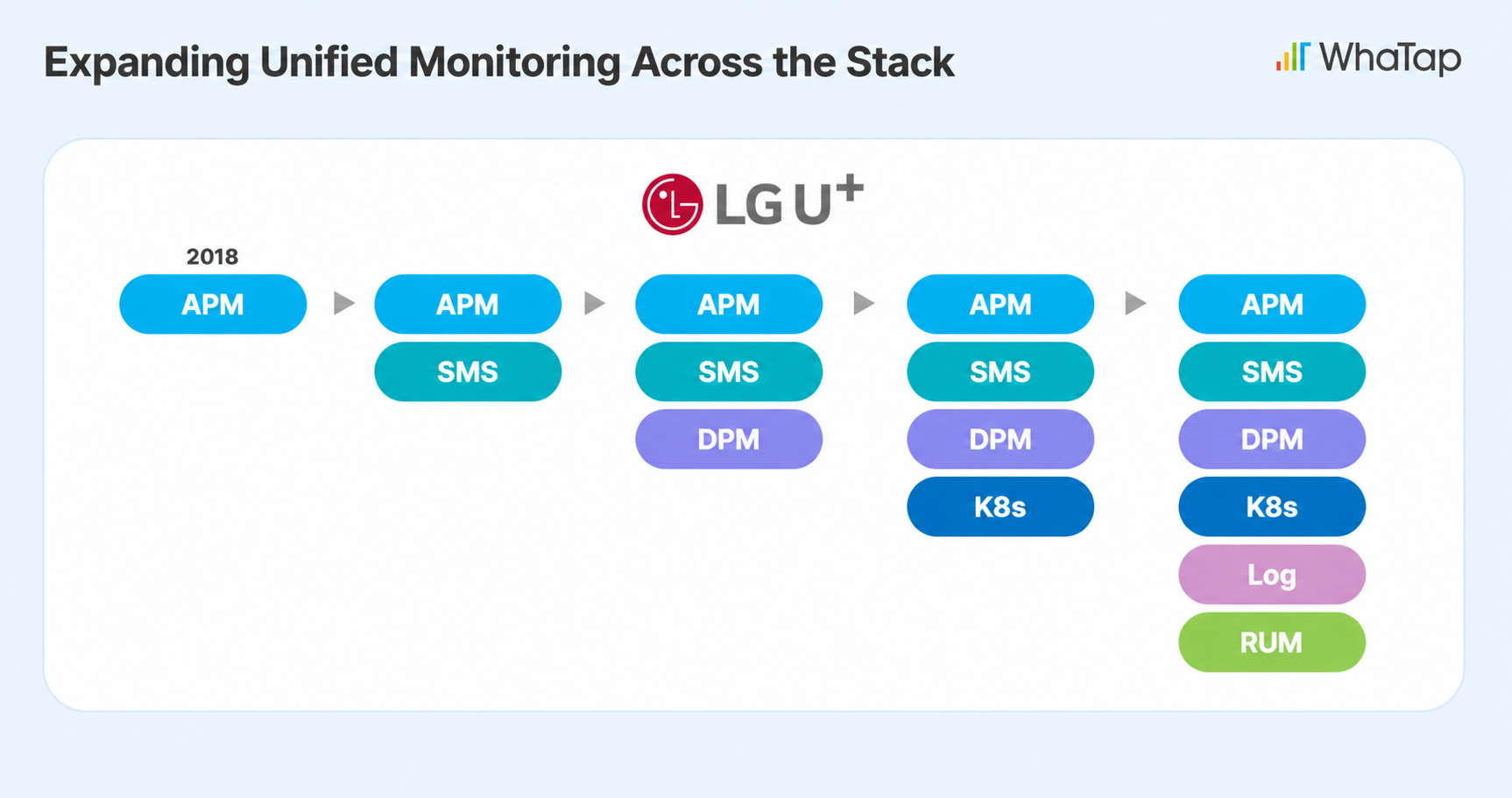
A key factor was WhaTap’s ability to provide consistent monitoring across the entire service stack—from infrastructure to the frontend—while allowing teams to access the metrics they need immediately through integrated dashboards.
WhaTap’s licensing model also helped LG U+ rethink its IT operations strategy beyond simply reducing costs.
With traditional monitoring solutions, adding more monitoring points often required purchasing additional licenses. As a result, teams had to selectively determine which systems were worth monitoring based on cost considerations.
WhaTap, by contrast, offered a flexible model that allowed LG U+ to expand monitoring points across its services without imposing the same restrictions.
Seungmin Shin of the IT Operations PI / Service Monitoring Team explains:
“I saw WhaTap’s licensing model as more than just a way to reduce costs. To me, it was essentially a message to ‘monitor everything you can.’ In the past, we had to decide what to monitor based on cost efficiency. Now, we have an environment where we can monitor all critical services without blind spots.”
Today, LG U+ operates its unified monitoring system using WhaTap’s powerful data APIs.
Rather than exposing WhaTap’s extensive raw monitoring data directly to every team, the service monitoring team uses the APIs to select and process the data each department needs and delivers it through customized dashboards.
This approach has delivered three key benefits.
1. Automated monitoring integration
When a new service is launched, its monitoring points are automatically integrated with WhaTap. This allows monitoring to begin immediately without requiring additional manual configuration.
2. Faster analysis and incident response
When deeper analysis is required, teams can drill down from the dashboard to the source of an issue in just a few clicks. This has significantly improved both root-cause analysis and incident response times.
3. Stronger operational governance
All event alerts are now generated and managed through a single framework. With greater confidence in the monitoring system, individual teams can spend less time managing monitoring operations and focus more on delivering and operating their services.
Consistent end-to-end monitoring revealed something that had previously been difficult for LG U+ to see: where performance problems were actually occurring.
For years, LG U+ had assumed that backend systems were the primary bottleneck affecting the user experience and had focused its optimization efforts accordingly. Yet those efforts produced limited improvements.
After adopting WhaTap and gaining visibility across the entire service stack, LG U+ discovered that a significant share of its performance bottlenecks was actually occurring in the frontend.
This insight changed the company’s approach.
Instead of limiting optimization efforts to the backend, LG U+ expanded its focus to the frontend as well—ultimately achieving meaningful improvements in the performance experienced by end users.
As service architectures become increasingly complex, monitoring is evolving beyond reactive incident management toward observability: an approach that uses AI and operational data to understand systems more proactively and comprehensively.
For LG U+, WhaTap is therefore more than a monitoring tool. It is a strategic partner helping the company understand and proactively respond to this shift in the technology landscape.
LG U+ plans to continue working with WhaTap to further advance its end-to-end monitoring capabilities and deliver seamless, high-quality digital experiences to its customers.
Looking to consolidate your monitoring environment and build unified, end-to-end visibility like LG U+?
Discover how WhaTap can help you build a more comprehensive monitoring and observability strategy.

%201.svg)


%201.svg)