.svg)
%201.svg)


%201.svg)
담당자가 프로모션 코드를 발송해 드립니다.
와탭을 경험해 보세요.
와탭을 경험해 보세요.
와탭을 경험해 보세요.
와탭을 경험해 보세요.
와탭을 경험해 보세요.
와탭을 경험해 보세요.
와탭을 경험해 보세요.
와탭을 경험해 보세요.
WhaTap AI를 경험해 보세요.
AI-Native Observability: What It Means and How WhaTap Is Building It
.webp)
Hello. We're WhaTap Labs, the AI-native observability platform.
Beyond being a newsletter greeting and homepage tagline, what does "AI-Native Observability" actually mean?
AI-Native Observability goes far beyond a surface-level brand message. It's a core strategic keyword that captures WhaTap's vision for transforming IT operations and the technical direction behind it.
Traditional monitoring was limited to collecting and visualizing data. AI-Native Observability aims for a next-generation operational model in which AI analyzes large-scale operational data in real time and connects anomaly detection, root cause identification, and recommended responses in a single, seamless flow.
In other words, it's a new observability paradigm that goes beyond simply showing more data — one that leverages AI-driven analysis to quickly identify the cause and scope of impact of incidents and helps teams determine the right course of action.
.webp)
This direction reflects structural shifts in today's IT operations landscape.
As cloud, microservices, and container-based architectures continue to spread, system complexity keeps rising, and the volume of operational data — logs, metrics, traces — is surging alongside it. Yet turning all this data into meaningful insights still takes significant time and effort.
Monitoring technology has advanced rapidly, yet data remains scattered across multiple tools and layers. This makes it difficult to interpret operational context holistically, and final decisions and responses still rely heavily on human experience and intuition.
As a result, operations teams end up spending a significant chunk of their time on repetitive alert handling and manual analysis. In practice, root causes are still identified through experience and guesswork rather than solid evidence — and teams struggle to break free from that cycle.
.webp)
To solve these problems, WhaTap aims to show how AI can redefine IT operational efficiency — from data interpretation all the way through to decision-making.
WhaTap's vision is not about AI fully replacing human work. Instead, it's about building an operational framework where humans and AI collaborate to resolve issues more efficiently. This frees operators from repetitive alert handling and manual analysis, allowing them to focus on higher-value decisions and strategic judgment.
In this issue, we take a closer look at the core technologies that make up WhaTap AI: OpsLake, a dedicated data lake built for AI; the RCA Agent, which autonomously reasons about root causes; and Copilot, a natural language-based operations interface. We'll walk you through a new approach to IT operations designed for practitioners, along with the direction we're headed.
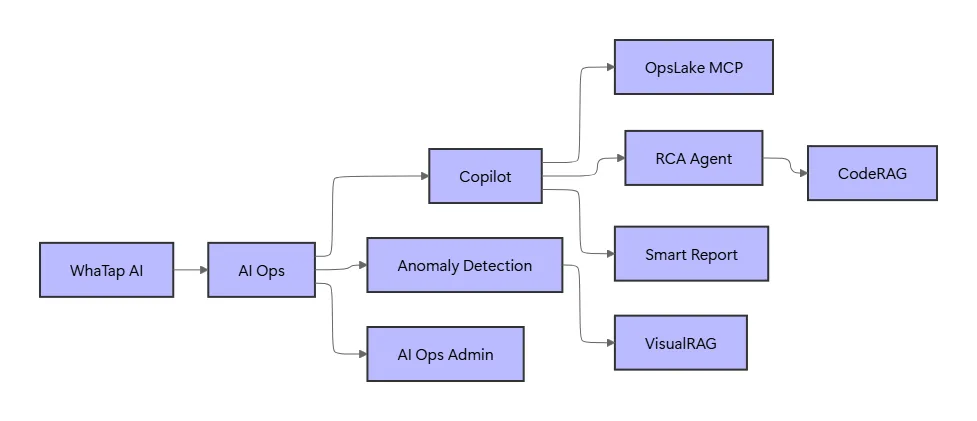
This article is based on the session "From Data Interpretation to Decision-Making: How AI Is Redefining Operational Efficiency" presented at WhaTap Observe Summit 2025, held in November.
OpsLake: A Dedicated Data Lake for AI Analysis
Achieving advanced AI-driven analysis starts with securing sufficient, well-structured data.
Traditional monitoring systems were designed around real-time processing and alerting, which made it difficult to accumulate and leverage the broad, long-term data that AI requires. To address this, WhaTap built OpsLake — a purpose-built data store optimized for AI analysis.
OpsLake systematically accumulates the long-term data and diverse operational context needed for AI analysis, all without affecting the stability or performance of the existing monitoring system. Real-time monitoring and alerting remain on the existing platform, while AI performs deeper, broader analysis based on data stored in OpsLake — a dual-track architecture.
As a result, OpsLake serves as the essential data foundation that WhaTap AI's RCA Agent, Copilot, and reporting features can reference at any time, functioning as the data hub that underpins AI-driven operational decision-making.
.webp)
RCA Agent: An AI-Powered Root Cause Analysis System
Traditional anomaly detection systems frequently generated false alerts based on simple pattern similarity, and often failed to pinpoint the actual root cause of issues. This left operators fatigued by excessive alerts and unable to focus on the incidents that truly mattered.
To overcome these limitations, WhaTap takes an analysis-and-response-oriented approach rather than a prediction-only model, actively leveraging large language models (LLMs).
At the heart of this is the RCA (Root Cause Analysis) Agent, which operates as an autonomous agent. This Agent doesn't just analyze surface-level metric data to reason about root causes. It also collects and analyzes "operational context" — such as resource states and load levels at the time of an incident — alongside "history-based knowledge" like past similar cases and runbooks.
The vast amount of collected data then goes through a Token Budgeting stage, where it is progressively summarized by priority. This enables accurate analysis while keeping the full context intact within the model's context window.
Through this process, the RCA Agent generates hypotheses for the root cause of issues on a per-service basis, calculates the scope of impact and severity, and delivers analysis results that include immediate, actionable remediation steps.
Most importantly, administrator evaluations and corrections are fed directly back into AI training as real-time feedback. Over time, the system becomes increasingly optimized for each customer's operational environment, evolving into an intelligent operations framework that avoids repeating the same failures.
.webp)
Copilot: An AI Operations Interface Powered by Natural Language
No matter how advanced AI technology becomes, its value is limited if users can't easily put it to work. WhaTap AI bridges operators and AI through Copilot, an intuitive natural language interface.
Operators no longer need to navigate complex dashboards one by one. A simple command like "Analyze yesterday's errors" is all it takes to surface the information they need. Copilot searches relevant data from OpsLake and, based on the RCA Agent's analysis results, provides an integrated briefing that covers the current situation, root causes, and recommended follow-up actions.
Report creation — a major part of day-to-day operations — also changes dramatically. Traditional templated reports struggled to meet the varying requirements of different clients. With Report Copilot, custom reports can be generated instantly using nothing more than natural language instructions.
For example, a request like "Add an active stack count chart and include an approval line" prompts the AI to review the relevant data and automatically assemble a document with visual elements. The generated report can be edited on the fly and exported in standard document formats for easy sharing, cutting down the time spent on report creation and boosting operational efficiency.
.webp)
Local LLM Support for Air-Gapped Environments
WhaTap considers not only technical completeness but also the real-world constraints that enterprises face.
Public institutions and large enterprises with strict security requirements often restrict the use of external LLM APIs. For these environments, WhaTap AI supports local LLMs, enabling organizations to safely leverage AI analysis capabilities even in air-gapped environments where data never leaves the network.
Local LLMs do present a technical challenge: structured output tends to be less stable compared to some commercial API models. WhaTap addresses this by applying clearly formatted prompts along with post-processing and augmentation techniques to ensure consistent, high-quality analysis responses.
This allows users to choose between commercial API models and local LLMs based on their security requirements, cost considerations, and performance criteria — and to flexibly adapt their AI strategy to their organization's infrastructure and operational policies.
.webp)
A New Standard for AI-Powered IT Operations, by WhaTap
WhaTap AI isn't just presenting a future vision — it's rolling out features in phased MVPs, continuously incorporating real user feedback. This approach raises technical maturity while validating practical, field-driven improvements.
Based on current analysis, AI adoption is expected to improve operational efficiency by approximately 70%, with incident prevention improving by up to 85%. Additionally, developer and operations productivity is projected to increase by around 60% as repetitive tasks decrease, while overall operational costs are expected to drop by roughly 30%.
Building on these quantitative improvements, WhaTap is advancing IT operations toward a model where AI goes beyond being a simple support tool and meaningfully improves overall operational efficiency and decision-making. The future we're aiming for is not one where AI makes every decision, but an operational framework where AI and humans collaborate to make faster, more accurate judgments.
.webp)
When all major features are officially released in Q2 2026, teams will be able to run more reliable services with fewer resources than ever before. This will free operators from repetitive response tasks, allowing them to focus on more strategic, high-value decision-making.
From data interpretation to decision-making — we invite you to look forward to the new standard for IT operations that WhaTap AI will deliver.
.webp)
.webp)


